Showing posts with label Sapir. Show all posts

Wednesday, April 24, 2013

Happy Birthday Benjamin Lee Whorf!

Since today is the 116th birthday of Benjamin Lee Whorf (he's not actually 116 as he's dead), we thought we'd pay homage to one of the great linguists of the 20th century. If you can subtract 116 from 2013 you will know that Whorf was born in 1897. What that sum will not tell you is that he was born in Winthrop, Massachusetts, where he also grew up.

Whorf was initially a fire prevention engineer, having graduated from MIT in 1918 with a degree in chemical engineering. It was his religious interests that first led him to studying linguistics. His analysis of Biblical texts eventually directed his focus towards the semantics and grammar of Biblical Hebrew.

Given that it borders the Atlantic, Whorf's hometown
of Winthrop, Massachusetts likely has a wharf.
Following his work with Biblical Hebrew, Whorf studied the Uto-Aztecan languages of Mexico and the Western United States. His work eventually culminated in applying for a grant to conduct a field study in Mexico, where he documented Nahuatl dialects.

After his time in Mexico, Whorf found himself heading to Yale and enrolling in a graduate programme. It was at Yale where he met Edward Sapir. Sapir would drastically change the way Whorf looked at linguistics. Eventually, they created the Sapir-Whorf Hypothesis, also known as the Whorf Hypothesis, which tells you who did most of the work!

The hypothesis of linguistic relativity, named in part as a pseudo-homage to Einstein's theory, explained that language affects the way you think and see the world around you. If this is true, which we like to think it is, then every language you don't know is limiting your ability to see the world around you! Get out there and learn some more!

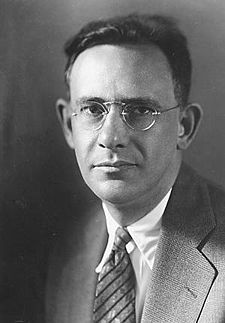
Saturday, January 26, 2013

Happy Birthday Edward Sapir!

Today, if you hadn't guessed by the title, is Edward Sapir's birthday. Unfortunately, he's dead. Fortunately, his legacy lives on the world of linguistics.

It's not a bad place to be educated.
Born to "German" parents, the place where he was born was actually in Prussia, which is now Poland. He moved to the U.S. where he studied Germanic linguistics at the University of Columbia, which is still one of the top language universities in the United States. It also allowed Jewish students in without any limitations, unlike other universities at the time.

His most important work included the classification of Native American languages. His work with Native American languages was even featured in the Encyclopædia Britannica. He took particular interest in the Athabaskan language family.

Sapir's other famous "work" included the Sapir-Whorf Hypothesis. Despite the name, Sapir never co-authored any work with Whorf and, in fact, never made a hypothesis. It's just a useful label put on to some of the work he did in terms of linguistic relativity, just like Whorf.

The Sapir-Whorf Hypothesis stipulated that the way people think, their cognitive processes, are affected by language. The idea that Inuits have several words for snow was an example used by Whorf to explain the hypothesis. It was, of course, found to be false.

Edward Sapir's work will be remembered for quite some time, not just amongst linguists, but also by everyone who wrongly quotes that "Inuits have hundreds of words for snow"!

Towards the end of his life Sapir was the head of Anthropology at Yale, where he continued to work on the relationship between anthropology and languages. Amazingly, few before him had thought that there'd be a link between the two!

He died in 1939 in New Haven, Connecticut.