Showing posts with label Olympic Games. Show all posts

Monday, August 8, 2016

The Etymology of the Olympics: Part 2

Before the weekend, we started looking at the etymologies of Olympic events. Today we'll finish up with the remaining events.

Pentathlon

Much like the Olympics themselves, this term has Greek origins. Since the pentathlon includes five events, it's a merger of the Greek word pente (meaning "five") and athlon (meaning "contest"). However, it used to be called the pentathlum, using the Latin name.

Rowing

This event gets its name through Proto-Germanic roots and lent itself to a variety of Northern European languages. When it arrived in Old English, the verb "to row" was rowan.

Rugby

Like "badminton", this sport gets its name from where the sport was first played. Rugby should really be called "rugby football". Rugby is a town in Warwickshire, England, if you were wondering.

Sailing

Like rowing, this sport's name also originates from Proto-Germanic. In Old English, the word was seglinge, but became sailing when the Old English word for "sail" changed.

Shooting

Shooting comes from Proto-Indo-European roots, and was scotung in Old English before referring to the sport as of 1885.

Swimming

Interestingly, the verb "to swim" was swimman in Old English, but "swimming" comes from making "swim" a verbal noun.

Taekwondo

Like judo, taekwondo is a way of doing something. In Korean, do is "a way or manner", tae means "to kick", and gwon means "to punch", so taekwondo is literally "the way of kicking and punching".

Tennis

Tennis comes from French; Old French, to be precise. In fact, it comes from the Old French verb tenir, which means to hold, receive, or take. The imperative form of this verb was tenez, which entered Middle English as tenetz and tenes. This evolved into the "tennis" we know today.

Triathlon

Remember pentathlon? The term triathlon is almost the same, but with pente being replaced by tri, meaning three, instead of five. It only has three events, rather than five.

Volleyball

The word volley comes from Latin volare, meaning "to fly", and then French volée. It eventually referred to the act of volleying the ball in tennis in the mid-19th century before combining with the word "ball" to give us the term "volleyball" that we use today.

Water Polo

The word for the game "polo" came from the Balti word for "ball", polo. Polo was played in Asia long before it made its way to England and was adapted for the water, at which point it became known as water polo.

Wrestling

Wrestling came from the Old English term wræstlung, while referring directly to the sport itself was the verbal noun of wræstlian.

Well, that's the remainder of our Olympic etymologies! We hope you enjoy the games as much as we surely will.
Monday, February 10, 2014

"Hot.Cool.Yours." What Does Sochi's Motto Even Mean?

Although I enjoyed the opening ceremony and over the weekend I've been immersed in a variety of winter sports that I wouldn't usually watch, one thing about the Sochi games has been niggling in the back of my mind. What does "Hot.Cool.Yours." even mean?

Whilst each word is separated by a full-stop (or period) it is very odd to have no spacing after each one. Why couldn't it have been written as "Hot. Cool. Yours."? This seems even weirder given that the Russian version appears to have been rendered as "Жаркие. Зимние. Твои.", complete with spaces.

Aside from the painfully poor spacing in the English version, let's have a look at the words. Initially, like most English speakers, we will look solely at the English translation as they will have no access to or understanding of the Russian language.

"Hot" or "Жаркие"

What does hot mean? It clearly can't refer to temperature. These are the winter games, after all. The events take place on ice and snow, so it can't be temperature. Does hot mean sexy? Sure, there are a lot of events where aerodynamics are key and as a result, skin-tight clothing is required. Regardless of your sexual preference, there is certainly a good amount of "eye candy" on display. However, we doubt this is what the marketing team were going for.

In fact, the Russian word "Жаркие" does refer to both heat and passion. The heat is apparently in reference to the heated competition and the passion of the games.

"Cool" or "Зимние"

As cool can refer to temperature and how fashionable something is, we're fairly happy with its inclusion as a fragment in this mantra of a motto. When the motto was announced, many preferred translating " Зимние" as "wintry". For me, "Hot.Wintry.Yours." is just as confusing and ambiguous as the official translation.

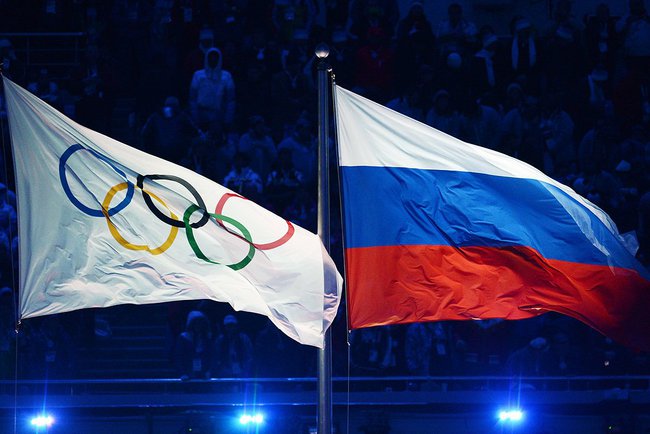
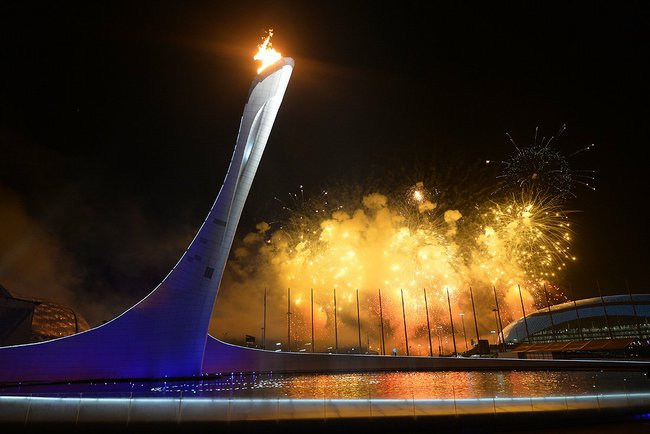
The Opening Ceremony at Sochi.
"Yours" or "Твои"

It seems that everyone, including the organisers and even the internet, is in agreement that "Твои" simply means "yours". Apparently this is because the games are "ours". As a Brit, I'm not so sure that the games are "ours", even if we are aiming for a record medal haul.

Whilst we could hope that "Жаркие. Зимние. Твои." is really clever and awesome in Russian and the English translation is just simply missing the beautiful nuances of the source language, it seems that some Russians think it's just as stupid as I do.

Sorry Sochi, we're really enjoying the games and the opening ceremony was cool, but we just can't deal with "Hot.Cool.Yours.".